ABOUT
The maestra
who asks why
Giselle Anne has spent four decades inside the tango — on the stages of its golden shows, in the milongas of Buenos Aires, and at the front of its most influential classrooms. She is one of the dancers who turned tango from something you inherit into something anyone, anywhere, can truly learn.
More than 50 cities of Japan, the Aldwych and the Champs-Élysées, a school in Sevilla, a technique class that did not exist before her — and a way of teaching that has since travelled to more than fifty countries.

1984 → 1986 · BUENOS AIRES
The academic and the self-taught
Ten years of classical ballet, contemporary dance and Argentine folklore at the National School of Dance in Buenos Aires, finishing with a qualification as a teacher of ballet; and, at the same time, dancing folklore with the Folkloric Ballet of the University of Buenos Aires.
Tango she taught herself, because in the mid-eighties almost nobody taught it. What lessons existed came from two of the great milongueros: Antonio Todaro and Pepito Avellaneda. It was her independent skill in observing and exploring that made her Tango.
1987 → 1990 · THE STAGES
More than 50 cities of Japan - the great shows
Four years on the road with the orchestras. Japan in 1987 with the San Telmo Ballet and the Jorge Dragone orchestra — Época de Tango, fifty-five cities. Then the Festival del Tango '87 through Lima, Cuenca, Quito and Guayaquil with Argentino Ledesma. The Metropolitan in Buenos Aires with the A Todo Tango ballet and Mariano Mores; the Ópera in Mar del Plata with A Todo Tango II, José Colángelo's orchestra and Libertad Lamarque; the Nuevo Apolo in Madrid with Los Creadores, Mores and Ariel Ramírez.
Japan again in 1988, this time as a solo couple with the Orlando Tripodi Quartet, Tokyo, Sendai, Nagoya, Okayama, and again in 1990, staging and directing the choreography for a tour of fifty-two cities with Los Solistas de D'Arienzo under Carlos Lazzari. Three tours, more than a hundred Japanese cities, and the beginning of her work as a choreographer.
In between, the tango houses and television studios of Buenos Aires: Michelangelo, Tango Mío, Grandes Valores del Tango, Venga a Bailar.
Watch: A Todo Tango with Mariano Mores, 1987 →
SHARED STAGES Libertad Lamarque · Argentino Ledesma · Mariano Mores · Ariel Ramírez · José Colángelo · Enrique Dumas · Los Solistas de D'Arienzo

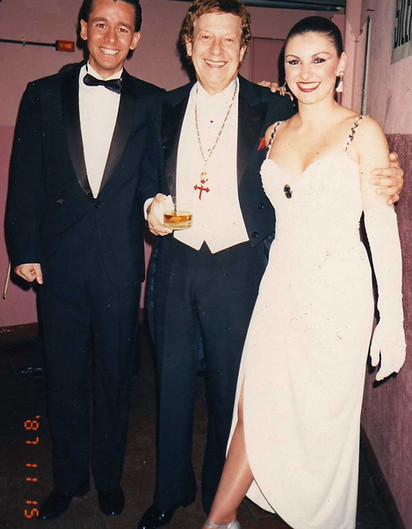
1991 · LONDON
Tango Argentino at the Aldwych
Four months at the Aldwych Theatre with Tango Argentino — the production that had opened Argentine tango to the world — sharing a stage with the most celebrated dancers of Buenos Aires, and the orchestras of the Sexteto Mayor and Carlos Berlingeri. She has called it the peak of her career.
The touring carried her on through the Costa del Sol, and then to Sevilla. She stayed five years.
1992–1998 · SEVILLA
Casa del Tango
Seven years in Spain building tango from the ground up. Her own company and her own ballets — Buenos Aires de Ayer y de Hoy, Estampas Porteñas, Tango, Humor y Fantasía, Del Conventillo al Teatro Colón — staged at the Montpensier and the Andalusian Theatre Centre, at the Higher School of Dramatic Art, at the University of Sevilla. A school that taught more than a hundred students and a company drawn from her own pupils. Choreography for the Díptico Atroz theatre company. Seasons in Málaga, Torremolinos, Granada, Córdoba, Santander; tours into France, Belgium and Portugal.
And in May 1997, the Casa del Tango: one of the first places in southern Spain given over entirely to tango, which is still going today.
The first proof that Giselle could not only dance the tradition, but build homes for it.
MONTE CARLO · APRIL 1995
A night at the Bal de la Rose
Monaco's Bal de la Rose was staged that spring as an Argentine cabaret, Monte-Carlo / Buenos-Aires, in the Salle des Étoiles of the Sporting Club, with the orchestra of Juan José Mosalini, the collaboration of Alfredo Arias, and Princess Caroline in the chair. Giselle danced the tango.
Elle ran the evening a fortnight later under the headline “Caroline secoue Monaco!” Two years after that, a Sevilla paper still recorded, with some satisfaction, that the royal family had been pleased.
It was not the only such evening. The previous August she had danced a tango gala at the Marbella residence of King Fahd of Saudi Arabia; two years later, the Châtelet in Paris.
Elle France · 17 April 1995 · El Correo de Andalucía · 1 February 1997 · See both in Press →
1995 · THE PIONEER
The technique class is born
In Europe, Giselle introduced something tango had never had: the individual technique class — balance, posture, your own movement, studied on its own, no partner required. Revolutionary then; standard practice in tango schools worldwide now. It remains the heart of what she teaches — live online, to students on every continent.
The same year, at a festival in Sitges, she met Gustavo Naveira.
1997 → 1998 · EUROPE AND THE US
Tango Pasión, and the last of the great tours
Fourteen months on the road with Tango Pasión and the original Sexteto Mayor: Hamburg and Düsseldorf, Palermo, the Roman theatres of Turkey — Ephesus, Aspendos, Antalya — Berlin, Bournemouth, Birmingham, Chichester, Edinburgh, Philadelphia, Norfolk, and finally the Théâtre des Champs-Élysées in Paris and a tour of France.
It was the end of one career and the beginning of another. From here on the work was teaching.
1995 → 2024 · WITH GUSTAVO NAVEIRA
The method that changed how tango is taught
They had met at Sitges in 1995 and danced together since; in 1999 they decided to make it a professional partnership. For the three decades that followed, Giselle Anne and Gustavo Naveira danced, taught and thought together — building a methodology on the structural analysis of tango movement. Out of it came the Progressive Tango Program, a sequence designed so that structure, technique and partner coordination are learned in the order that makes them make sense, and the Tango Teaching Training, which teachers on several continents have now completed.
They also invented a format: the seminar, a week given over to a single subject, some twenty hours of it, followed all the way down. And a show, Tango Generations, in versions for three couples and for five, which toured America and Europe with the next generation of dancers. Their approach is credited with reshaping modern tango pedagogy, and was the subject of the 2021 documentary The Naveira Method.
Read: the Todo Tango conversation with Gustavo and Giselle →
If you already teach Argentine Tango and want to sharpen what you do — or you want to learn to teach — the progressive program is where to start.
2003 → · BUENOS AIRES
The seminars, and a seat on the jury
Back in Buenos Aires, the seminar found its audience — first at the Club Español and La Papelera, from 2003, and from there out to festivals everywhere. In 2004 Giselle sat on the jury for the Stage Tango category at the Buenos Aires International Tango Championship, and taught its masterclasses. The festivals have since run to more than fifty countries.
2010 → 2020 · BOULDER DANCE STUDIO
A studio, a festival, a community
The Boulder Tango Festival came first: ten years of it, from 2010, drawing dancers and orchestras from across the globe to their adopted hometown. The Boulder Tango Studio followed in 2013 — seven years in which the method was tested daily on a real school — and was named Best Tango Academy by Premios Tango, Argentina, in 2018.

TODAY · EVERYWHERE
The next step is yours
Giselle teaches seminars across Europe, the Americas, Asia and Oceania — and online, live from her studio to living rooms around the world.
Her current work focuses on understanding tango through both roles of the couple, drawing on her deep experience from within both sides of the dance.
Her teaching is grounded in the Tango Methodology, developed through years of intellectual study and analysis of the dance, with a carefully designed progression that allows each dancer to develop their understanding and abilities step by step.
Forty years of asking why the tango works, still teaching the answer.
THE RECORD
Forty years, in detail
Stage and orchestra, 1984–1991
-
1984–86 Folkloric Ballet of the University of Buenos Aires
-
1987 Japan, 55 cities, with the San Telmo Ballet — Época de Tango, Jorge Dragone orchestra with Enrique Dumas and the Cuarteto del Centenario
-
1987 Peru and Ecuador — Festival del Tango '87: Lima, Cuenca, Quito, Guayaquil, with Argentino Ledesma and the Dragone orchestra
-
1987 A Todo Tango with Mariano Mores — Teatro Metropolitan, Buenos Aires; Teatro Roma, San Luis; Channel 9 tribute to Libertad Lamarque
-
1988 A Todo Tango II — Teatro Ópera, Mar del Plata, with José Colángelo's orchestra and Libertad Lamarque, Premio Estrella de Mar; later Santa Fe, Michelangelo, and Las Leñas with Mores
-
1988 Japan as a solo couple — Tokyo, Asahikawa, Okayama, Wakayama, Sendai, Nagoya; Orlando Tripodi Quartet, choreography by Giselle
-
1989 Los Creadores with Mariano Mores and Ariel Ramírez — Teatro Nuevo Apolo, Madrid
-
1990 Japan, 52 cities — Los Solistas de D'Arienzo, directed by Carlos Lazzari; staging and choreography by Giselle
-
1990 Teatro Astral, Buenos Aires — La Gran Noche de Milongas for FM Tango, Julián Plaza orchestra
-
1990–91 Tango Mío, Buenos Aires; Chile with the Tango Mío show
-
1991 Tango Argentino — Aldwych Theatre, London, May to August; Sexteto Mayor and Carlos Berlingeri orchestras
Buenos Aires tango houses
-
Michelangelo · Tango Mío · Señor Tango
Spain, France and Belgium, 1992–1998
Her own productions
-
Buenos Aires de Ayer y de Hoy — Higher School of Dramatic Art and Dance, Sala Dada, Teatro Gutiérrez de Alba, Teatro Montpensier, Sevilla (1993)
-
Estampas Porteñas — A Night at the Opera (1993)
-
Del Conventillo al Teatro Colón — Polytechnic University of Sevilla (1993)
-
Tango, Humor y Fantasía — Fair of Nations, touring Granada, Córdoba, Santander, Sevilla, Málaga, Almería (1994–96)
-
De Gardel a Gardel — Lisbon and Setúbal, Motril, 8th Granada Tango Festival (1996)
-
Buenos Aires, tú y yo — City Council of Sevilla (1996)
-
Choreography for the Díptico Atroz theatre company, Sevilla (1992)
Festivals and galas
-
1994 Pasión de Tango — 1st International Tango Festival, Sitges
-
1994 Tango gala at the Marbella residence of King Fahd of Saudi Arabia
-
1995 Monte-Carlo / Buenos-Aires — Bal de la Rose, Salle des Étoiles, Monte-Carlo Sporting Club, chaired by Princess Caroline; Mosalini orchestra
-
1995 Paris–New York to Buenos Aires — Les Rencontres du Sud, Toulouse; La Nuit de la Passion, Ghent
-
1995 II World Tango Summit and 7th International Festival, Palacio de Congresos, Granada
-
1995–98 Sitges International Tango Festival, editions II to V
-
1996–98 L'Académie d'Été, Neufchâteau, Belgium — with the Mosalini and Marcucci orchestras and Marcelo Mercadante
-
1997 Théâtre du Châtelet, Paris — press awards gala
-
1997–98 Fascinación de Tango and Malevos de Buenos Aires — Théâtre de l'Empire, Paris
-
1998 Festivals in Aarhus, Oslo, Bardolino, Graz, Vienna, London, Bologna, Padova; Tango Magia, 1st Amsterdam festival
Tango Pasión, with the Sexteto Mayor, 1997–98
-
Germany — Musikalische Theater Hamburg · Tonhalle Düsseldorf · Theater der Freien Volksbühne, Berlin
-
Italy — Summer Festival, Palermo
-
Turkey — Istanbul, Ephesus, Denizli, Aspendos at Antalya, Ankara
-
England and Scotland — Bournemouth, Birmingham, Chichester, Edinburgh
-
United States — Norfolk, Philadelphia
-
France — Théâtre des Champs-Élysées, Paris, then Nice, Bordeaux, Toulouse, Avignon, Dijon, Bayonne and others
Institutions
-
1993 Tango History Seminar, University of Sevilla
-
1997 Casa del Tango, Sevilla — founded May
Choreography
-
1988, 1990 Staging and group choreography, Los Solistas de D'Arienzo and Orlando Tripodi Quartet, Japan tours
-
1988 Tango scene for the film Departamento Cero, Buenos Aires
-
1992 Díptico Atroz theatre company, Sevilla
-
1993–96 Her own stage works in Spain (above)
-
2005 Fracanapa, Buenos Aires
-
2010 Sinfonía de Arrabal, Basel
-
2011–13 Tango Generations, America and Europe — versions for three and five couples, co-created with Gustavo Naveira
Television, film and documentary
-
1987–90 Grandes Valores del Tango, Channel 9, Buenos Aires — including a show with Libertad Lamarque — watch the 1987 appearance
-
1987–90 Tango Bar and Venga a Bailar, Channel 2, Buenos Aires
-
1988 Departamento Cero, dir. Martín Donovan — choreography and performance of a tango scene, filmed in Buenos Aires, danced with "El Alemán"
-
1989 Naked Tango, dir. Leonard Schrader — filmed August 1989, released 1990; danced with "El Alemán"
-
1991 The C.I.D., British television — filmed on the Costa del Sol
-
2021 The Naveira Method — documentary on Giselle Anne and Gustavo Naveira, by the Argentine Tango Society, London and the US - watch on YouTube
Teaching, awards and recognition
-
1995 Pioneered the individual tango technique class, teaching alone in Europe
-
1997 Founded the Casa del Tango association, Sevilla
-
1998→ Festivals in more than fifty countries — see the flyers →
-
2003→ The week-long seminar — Club Español and La Papelera, Buenos Aires, then worldwide
-
2004 Jury member, Stage Tango category, and masterclasses — Buenos Aires International Tango Championship
-
2010–19 Boulder Tango Festival, co-produced for ten years
-
2013 Boulder Tango Studio, co-founded with Gustavo Naveira
-
2018 Best Tango Academy, Premios Tango Argentina — Boulder Tango Studio
Written about
-
Inside Tango Argentino, Antón Gazenbeek
-
Die Maestros des Tango Argentino, Susanne Mühlhaus
-
TangoDanza — features in issues 85 (2021) and 92 (2022); cover, issues 14 (2003) and 64 (2015)
Elsewhere on the web
-
Todo Tango — a conversation Interview
-
Casa del Tango, Sevilla History of the association
-
CityDance — Famous Tango Dancers Profile
-
Stafforini Tango Archive
-
Giselle Anne & Diana Cruz Projects shared
-
Tengo una Pregunta para vos Interview by Pepa Palazon